
Curriculum & Launches • Nov 8, 2026 • 16 min read
AI Engineer Training: How to Choose the Right Program in 2026
By AI Training Finder Editorial Desk
Executive takeaways for AI students
- Good AI engineer training teaches you to build on foundation models: model APIs, RAG, agents, evals and deployment, not only prompting or theory.
- Prices run from free courses to $10,000-plus for degrees and multi-course certificates; the live cohorts we list cost $3,000 to $4,500.
- Finishing is its own challenge: in one MOOC study, 46% of paid "verified" learners completed versus 3.13% of all participants.
- Treat placement rates as marketing until a program shows its method; the CFPB found one bootcamp advertising 71–86% while internal data showed about 50%.
The best AI engineer training teaches you to build software on top of foundation models: calling model APIs, retrieval (RAG), agents, evaluations and deployment. Which program fits depends on three things: what you already know, how much feedback and structure you need, and your budget. This guide compares the six main types of training, with dated prices, and shows how to check a program before you pay.
Prices and program details checked November 2026. Exam fees and prices are dated and linked to each provider's page; check them again before you enroll. AI Training Finder doesn't sell training, and our methodology explains how we compare programs.
What a good AI engineering program should teach
AI engineer training should teach you to build reliable applications with existing models, not to research new ones. If a program spends most of its time on prompt tricks or on math with no shipped project, it's preparing you for a different job.
Chip Huyen, author of O'Reilly's AI Engineering, describes the field as "the process of building applications with readily available foundation models". Our step-by-step AI engineer roadmap breaks that work into stages, and the AI engineer skills checklist turns each one into a self-test. A complete curriculum covers most of them:
- Software foundations: Python, web APIs, Git, testing and deployment.
- LLM fundamentals: tokens, context windows, embeddings, and what models get wrong.
- Model APIs: structured output, tool calling, streaming, cost and rate limits.
- Retrieval (RAG): chunking, embeddings, vector search and grounding answers in your own data.
- Agents: multi-step workflows, tool use, and when not to use an agent.
- Evals and reliability: test sets, automated grading, tracing and regression checks.
- Security and deployment: prompt injection, data handling, monitoring and cost control.
The major cloud certifications now include generative AI and agents. Google says its current Professional Machine Learning Engineer exam "covers tasks related to generative AI, including building AI solutions using Model Garden and Vertex AI Agent Builder." Microsoft's AI-103 certification validates "designing, developing, and deploying advanced Azure AI solutions using Python and Microsoft Foundry."
Evals deserve a special check. They're what separates a demo from a product, so look for them by name in the syllabus. Skepticism about AI output is common: in the Stack Overflow 2025 Developer Survey, 46% of respondents said they distrust the accuracy of AI tools, against 33% who trust it. A good program teaches you to measure that accuracy, not assume it.
If you're still deciding whether this is the right role, start with what an AI engineer does day to day or the AI engineer vs. ML engineer comparison. ML engineering training puts more weight on training and operating models.
Who this guide is for
This guide is for three kinds of readers, and each one should weigh the options differently.
- Software engineers moving into AI engineering. You already ship code, so you can skip beginner programming. Look for training that starts at model APIs and spends real time on RAG, agents and evals. Free and low-cost material often covers most of what you need.
- Career switchers. If you don't program yet, the first months are about software fundamentals. Feedback on your code matters most here, which is where mentored programs earn their price.
- Managers buying training for a team. You need consistent coverage across a group, a way to check progress, and often group pricing. See the section on team training below.
Six types of training compared
AI engineer training comes in six main formats: free courses, subscription platforms, live cohort courses, bootcamps, university certificates and degrees, and cloud certifications. They differ most in price, feedback and how much they push you to finish.
| Type | Example prices (as of Nov 2026) | Feedback on your work | Best for |
|---|---|---|---|
| Free courses | $0 | None or community only | Experienced developers who self-direct |
| Subscription platforms | From about $28 a month | Automated exercises | Learners who want structure at low cost |
| Live cohort courses | $3,000 and $4,500 (two examples) | Live sessions, some review | Developers adding one skill fast, with peers |
| Bootcamps | $4,995–$9,995 (one example) | Instructors and mentors | Career switchers who want a full program |
| University certificates and degrees | $3,900 to $10,000+ | Graded coursework | People who want a formal credential |
| Cloud certifications | $150–$300 per exam | None; you pass or fail | Proving skills on one cloud platform |
The prices above come from the examples below, each checked on the provider's own page in November 2026. Use them as examples of what each type costs, not a ranking or a full market survey.
Free courses
Free courses teach the concepts well, but you set the pace and nobody reviews your code. The Hugging Face LLM Course is "completely free and without ads", with no certificate. The Hugging Face AI Agents Course is also free and offers a certificate of completion for finishing its assignments and final challenge. fast.ai's Practical Deep Learning for Coders is "a free course designed for people with some coding experience", aimed more at training models than at building LLM apps.
Free courses work best for experienced developers who already know how to finish what they start. Pair them with official model-provider documentation and your own projects.
Subscription platforms
Subscription platforms give you a structured path, hands-on exercises and certificates for a monthly fee. DataCamp's Associate AI Engineer for Developers track is included in its Premium plan at $28 a month billed annually. DeepLearning.AI's Retrieval Augmented Generation course can be audited for free, but its course page notes that "if you audit the course for free, you will not receive a certificate."
The risk is the same as with free courses: completion depends on you. Check whether the projects are open-ended builds or fill-in-the-blank exercises.
Live cohort courses
Live cohort courses run for a few weeks with a fixed schedule, live sessions and a group of peers. They suit working developers who want to add one skill fast. AI Makerspace's AI Engineering Bootcamp (despite the name, a short cohort course sold through Maven) costs $3,000 for a six-week live cohort, with 4 hours a week of live sessions plus 1–10 hours of technical challenges. Parlance Labs' AI Evals for Engineers & PMs costs $4,500 and asks for 3–5 hours a week for 8 weeks.
Cohort courses are usually narrower than bootcamps. Check the syllabus against the curriculum list above to see which gaps a course fills.
Bootcamps
Bootcamps are longer, fuller programs with instructors, mentors and often career services. They're built for career switchers. Fullstack Academy's Part-Time AI & Machine Learning Bootcamp runs 23 weeks, live online, with a $9,995 list price that drops to $4,995 if you pay upfront or $5,995 in four installments.
At this price, outcome claims matter. See how to check a program before you pay below.
University certificates and online degrees
University programs give you a recognized credential and graded coursework, but they move slower and some lean toward classic machine learning rather than LLM applications.
- eCornell's Machine Learning Certificate costs $3,900 and takes 4 months at 6 to 9 hours a week.
- MIT Professional Education's Professional Certificate in Machine Learning & AI requires 16 or more days of qualifying courses, priced at $2,500 to $4,900 each, plus a $325 non-refundable application fee.
- The University of Texas at Austin's online Master of Science in AI is priced at $10,000 plus fees for 10 courses.
A degree makes the most sense if you want research-track roles or an employer requires a formal degree. For application work, check how much of the program covers LLMs, RAG and agents.
Cloud certifications
Cloud certifications prove you can build AI on one vendor's platform. They're exams, not training, so pair them with a prep course and projects.
| Certification | Exam fee | Notes (as of Nov 2026) |
|---|---|---|
| AWS Certified Generative AI Developer – Professional | $300 | 180 minutes, 75 questions; AWS recommends 2+ years building production applications on AWS |
| AWS Certified Machine Learning Engineer – Associate | $150 ($75 for the MLA-C02 beta) | The updated MLA-C02 exam has been in beta since September 29, 2026; the last day for the English MLA-C01 exam was September 28, 2026 |
| Databricks Certified Generative AI Engineer Associate | $200 | Each attempt costs $200 |
| Google Cloud Professional Machine Learning Engineer | $200 | Now covers generative AI; Google recommends 3+ years of industry experience |
| Microsoft AI-103: Azure AI Apps and Agents Developer Associate | Varies by country | Replaced AI-102, which Microsoft retired in 2026 |
Exams change often. AWS opened the standard version of the Generative AI Developer exam in March 2026 after its beta. Microsoft announced that AI-103 would replace the Azure AI Engineer Associate on June 30, 2026. Check that a prep course targets the current exam code before you buy it.
How to choose AI engineer training: five questions
To choose AI engineer training, answer five questions in order: where you're starting, what you're missing, how much feedback you need, what you can spend, and whether you need a credential.
- Where are you starting? If you already ship production code, skip any program that spends weeks on Python basics. If you don't program yet, make sure the program teaches software fundamentals first.
- Which skills are you missing? Compare your skills to the curriculum list above. Many developers only need RAG, agents and evals, which a short cohort or free course can cover.
- How much feedback do you need? Code review and deadlines are the main things you pay for. If you've struggled to finish self-paced courses before, budget for a program with live sessions or mentors.
- What can you spend, in money and hours? Count the weekly hours as well as the price. A $3,000 cohort that asks for 10 hours a week may cost more of your time than you have.
- Do you need a credential? Some employers, especially cloud-heavy ones, list certifications in job posts. Others care only about what you've built. Read the posts you're targeting.
| If you are… | Start with | Add if needed |
|---|---|---|
| A developer who self-directs well | Free courses plus model-provider docs | A short cohort on evals or agents |
| A developer who wants structure | A subscription track or live cohort | A cloud certification for your target stack |
| A career switcher | A bootcamp or mentored program with fundamentals | A portfolio project review |
| Targeting a cloud-heavy employer | Cloud certification prep plus projects | A cohort course for skills the exam skips |
| Aiming at research roles | A university degree | Research projects and papers |
Whatever you pick, plan to ship projects. The work you can show matters more than the certificate, and our roadmap's portfolio stage lists projects that prove each skill.
Self-paced vs. cohort-based training
Self-paced training is cheaper and more flexible, but finishing is up to you. Cohort-based training costs more and adds deadlines, peers and live help, which can help people who struggle to keep going alone. No study we found compares the two directly, but MOOC data shows how much completion varies.
The best evidence on completion comes from massive open online courses (MOOCs). A 2019 study in Science by MIT researchers Justin Reich and José A. Ruipérez-Valiente, reported by Inside Higher Ed, looked at MIT and Harvard courses on edX. Only 3.13% of all participants completed their courses in 2017–18, against 46% of "verified" learners who had paid for a certificate. MIT's Teaching Systems Lab summarized that low completion "has not improved over 6 years."
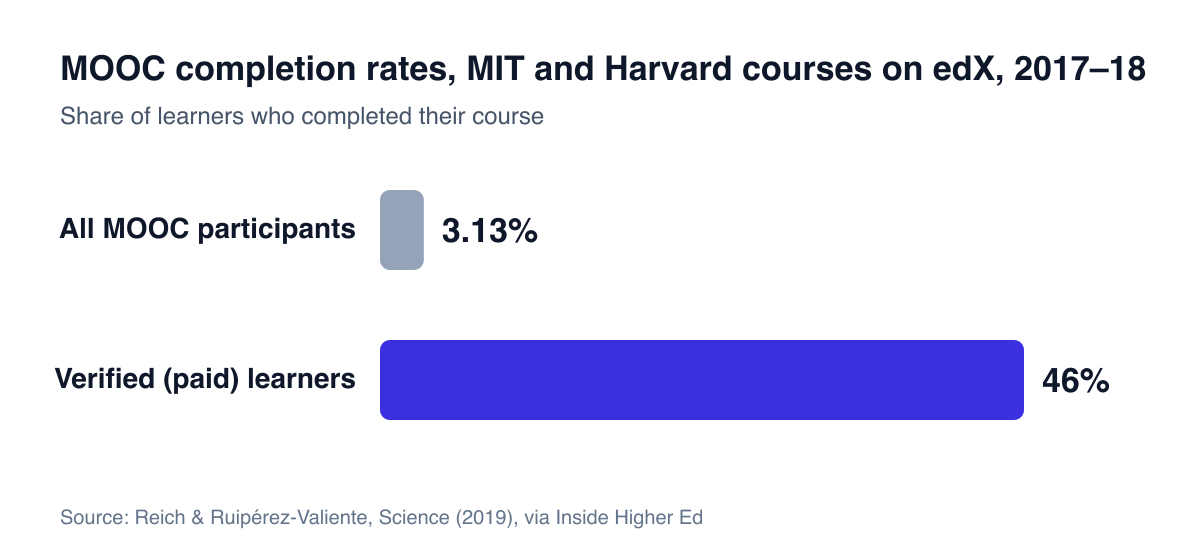
Source: Reich and Ruipérez-Valiente, Science (2019), as reported by Inside Higher Ed.
Two cautions apply. These are free and low-cost online courses, not AI bootcamps, and people who pay were probably more motivated to begin with. We found no independent study that compares cohort and self-paced completion directly. Still, the gap is a reminder that finishing is its own challenge, separate from the quality of the content. If you choose self-paced training, add your own structure: a schedule, a study partner, or a public project deadline.
How to check AI engineer training before you pay
Before you pay for AI engineer training, check six things: the curriculum, the projects, who gives feedback, how outcomes are measured, what graduates say, and the refund terms.
- Curriculum: does it cover RAG, agents, evals and deployment, or stop at prompting? Ask for the full syllabus, not the marketing page.
- Projects: will you finish with deployed projects you can show employers, built by you rather than copied from a template?
- Instructors and feedback: who reviews your code, how often, and what's their background in building AI products?
- Outcomes: are job results published with a clear method, a time frame and the share of graduates counted?
- Reviews: are reviews from verified graduates? Our review guidelines explain how we verify them.
- Refunds and financing: what happens if you drop out after two weeks? Read loan and installment terms before you sign.
Why placement rates need a second look
Placement rates are the claim most worth checking, because they're easy to inflate. In 2024 the US Consumer Financial Protection Bureau took action against the coding bootcamp BloomTech. The CFPB said BloomTech advertised that 71 to 86 percent of students were placed in jobs within six months, while its non-public reporting to investors showed rates "closer to 50 percent" and in some cases "as low as 30 percent."
When a program quotes a placement rate, ask:
- What share of all enrolled students does the figure cover, including those who dropped out?
- What counts as a placement: any job, or a job in the field they trained for?
- How long after graduation was it measured?
- Who checked the numbers? If a school says it reports under a voluntary standard such as CIRR, whose members commit to "reporting 100% of student outcomes," ask for the latest report.
New federal rules offer a useful benchmark. To qualify for Workforce Pell grants, short programs need a verified completion rate and job placement rate of at least 70%, and graduates' value-added earnings must at least equal the program's published tuition and fees, according to the Congressional Research Service. A program that can't tell you its completion rate at all is a warning sign.
AI engineer training cost and ways to pay
AI engineer training costs anywhere from nothing to $10,000 plus fees for an online master's degree, and multi-course certificates such as MIT's can cost more. The live cohorts we list cost $3,000 and $4,500, and our bootcamp example costs $4,995 to $9,995 depending on how you pay. Employers, tax rules and some public programs can cover part of it.
- Employer tuition assistance. Through a written educational assistance program under Section 127, an employer can pay for your education tax-free. The IRS confirms you won't pay tax on the first $5,250 of those benefits per calendar year for 2025 and 2026, and the limit will be adjusted for inflation after 2026. Many live programs fall under that figure, so ask your manager or HR.
- Workforce Pell grants. Federal Pell grants for short job-training programs took effect on July 1, 2026. Eligible programs provide at least 150 and fewer than 600 clock hours of instruction over at least 8 but fewer than 15 weeks, must be approved by the state, and must meet the completion, placement and earnings rules above. Ask a program directly whether it qualifies.
- WIOA training funds. Each state keeps a list of eligible training providers with performance and cost information, and workforce funds can pay for programs on it. These funds give priority to people on public assistance and other low-income adults; dislocated workers get services through American Job Centers.
- Installment plans and discounts. Many programs offer upfront discounts or monthly plans, like the bootcamp and university examples above. Compare the total you'll pay, not the monthly figure.
Cloud certification exams add $150 to $300 per attempt. Budget for a retake: Databricks, for example, says every attempt costs $200.
You can compare AI engineering programs by price and format to see current costs side by side.
AI engineer training for teams
For teams, the right AI engineer training is the one that gets people building and keeps them practicing afterward. Surveys show employers' plans to upskill running ahead of the training workers say they actually get.
In Microsoft's 2025 Work Trend Index, 47% of leaders listed upskilling existing employees as a top workforce strategy for the next 12–18 months. Yet a Jobs for the Future survey reported by CIO Dive found only 31% of workers said their employer provides AI training. BCG's AI at Work 2025 found only 36% of employees feel adequately trained, and those who received five or more hours of training were significantly more likely to become regular users.
When buying for a team:
- Assess first. Find out who already ships LLM features and who is starting from zero, then split the group.
- Train on your stack. Choose training that uses the model provider, cloud and data your team already works with, or plan a follow-up project that does.
- Make it hands-on. Tie the course to a real internal project with an eval set, so the skills stick.
- Ask about group pricing. Some cohort programs list team rates; AI Makerspace, for example, shows a lower per-student group rate for its FDE certification.
- Use the tax rules. Section 127 covers employer-paid training up to the limit above.
Frequently asked questions
Which AI engineer training is actually worth the money?
The training worth paying for is the one that fills your specific gaps with feedback you can't get for free. Experienced developers can often cover the concepts with free courses and spend money only on a short cohort for evals or agents. Career switchers usually get more from a mentored program. Whatever you choose, judge it by the projects you finish.
Should I get a certification or build projects first?
Build projects first, then add a certification if the jobs you want ask for one. Projects show you can ship. A certification shows you know one cloud platform, which matters most at employers that run on AWS, Azure or Google Cloud.
Is a degree, a bootcamp or self-teaching best for AI engineering?
It depends on your starting point and goal. Self-teaching works for experienced developers who finish what they start. Bootcamps suit career switchers who need structure and mentors. A degree makes most sense for research roles or when you need the formal credential. The AI engineer roadmap shows what to learn in each case.
How long does AI engineer training take?
It ranges from a few weeks to a few years. The live cohorts above run 6 to 8 weeks, the Fullstack Academy bootcamp runs 23 weeks, and eCornell's certificate takes about 4 months. Online master's degrees take longer; check each program's expected pace. Experienced developers can often skip ahead.
Next steps
- Check your skills against the curriculum list at the top of this guide and write down your two or three biggest gaps.
- Use the five questions and the table to pick a training type, then shortlist two or three programs.
- Check each one against the "before you pay" list, and ask about employer funding before you enroll.
Compare AI engineering programs side by side on curriculum, format and price, browse all schools and providers, and read verified graduate reviews before you decide. Know a program we should list? Contact us.
- #ai engineer training
- #ai courses
- #bootcamps
- #certifications
- #career change